Bass triad exercises: 15-minute daily workout
How to learn and practise triads on bass
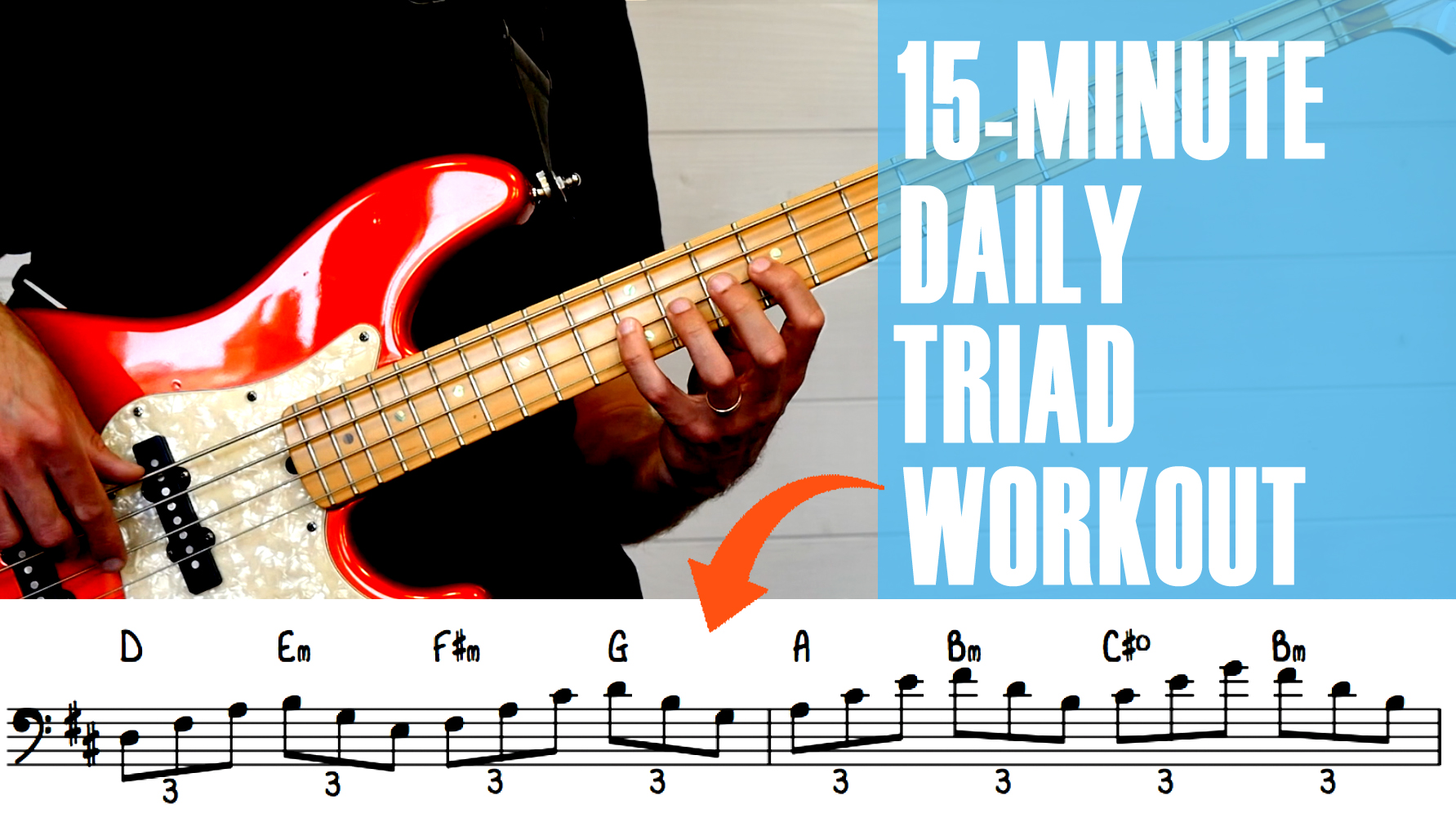
This video takes you through some of the best triad exercises that I developed for my personal practice and use all the time in my teaching. I’ve condensed everything into a 15-minute routine that you can follow along with and incorporate into your practice schedule.
If you’re not sure exactly what triads are, or don’t know the best ways to play them yet, then I’d suggest starting with this post, which serves as a primer: triads for bass guitar.
The exercises are centered around developing your understanding of the triads that are built from the major scale, your fluency in playing them, and your ability to hear their characteristic sounds when playing with other musicians, or working out songs by ear.
Here’s a rundown of the exercises covered in the video:
Part 1: positional triads
I’m calling this ‘positional triads’ because all of these exercises fit under the hand without changing position, much like many basslines that we end up playing on gigs. Don’t worry, we’ll do plenty of work on moving around the fretboard later.
1. Spell and play the major scale
It doesn’t matter which key you do the triad workout in, but it does matter that you know what the pitches are. Spell the scale (it’s fine if you need to look it up), write it down on paper so you remember it, then play it while thinking about (or, preferably, calling out) the note names.

2. Ascending triads in quarter notes
Play through the triads that are built from the scale, ascending though each of them, until you reach the highest note in the position.

Then play back down through the triads, but still ascend everything – you should always be playing root – 3rd – 5th on each triad:

3. Ascending triads, eighth notes
As above, but twice as fast! If you’re new to the workout and can’t play the triads cleanly and accurately in eighth notes yet then don’t worry – just skip this bit for now.


4. Descending triads in quarter notes
We’re still working through the triads in order, but this time we’re playing everything descending (5th – 3rd -root). Most people find this far more challenging than the ascending version because they have to visualise the entire triad before they can start playing it.


5. Descending triads in eighth notes
The rules still apply – if it isn’t clean and accurate, you’re not ready yet.


6. Alternating: ascending and descending
Let’s try playing up one triad and down the next: root – 3rd – 5th, then 5th- 3rd – root. For me, this is the point where the workout starts to sound less like exercises and more like music.


You can run this step in quarter notes, eighth notes, eighth note triplets, and even 16th notes if you have the chops.
7. Alternating: descending and ascending
As above, but reversed!


Part 2: two octave triads
This portion of the workout will get you very familiar with two practical fingerings for major, minor, and diminished triads across two octaves.
1. Two octave triads in quarter notes
Below are the fingerings that I use for major, minor and diminished triads in two octaves. You’ll notice that the first octave is the obvious, ‘common-sense’ fingering, while the second octave always starts with finger 4 (or 3). This increases your range of options when you’re exploring a new piece or improvising.
Two octave major triad fingering

Two octave minor triad fingering

For E minor, you’ll have two options on your bass: from the 12th fret of the E string, and from the open string. Try both!

Two octave diminished triad fingering

You’ll also notice that these all include a giant shift up and down the fretboard, which is hard to make sound good. This is a deliberate decision: if you can make the first and second octaves sound connected (and not slide everywhere), then you’re doing a great job.
2. Two octave triads, descending
Just as in part 1 of the workout, starting with the descending version of the triad is much harder, because you have to have an awareness of every note in the triad rather than just the root.



3. Ascending/descending triads, eighth notes
Now we get to mix and match directions, as well as visiting a different rhythmic subdivision:


4. Descending/ascending triads in eighth note triplets
As a fun challenge to end on, let’s see if we can crank out the triads in triplets while mixing directions:


You can get a full transcription of the entire workout here. Save it, annotate it, transpose it, improve it!
15-minute triad workout sheet music PDF

Struggling with syncopation?
Put yourself through the bootcamp!
Rhythm Reading Bootcamp Volume 2 is the exact method that I use to help my students master advanced rhythmic concepts. Over 80 carefully written exercises to build your confidence with 16th-note patterns and syncopation.