Joe Dart’s ‘Christmas in L.A.’ bassline transcribed in full
One of the funkiest festive songs around (my vote for the top spot is still Donny Hathaway’s ‘This Christmas’), Vulfpeck’s ‘Christmas in L.A.’ is the perfect antidote to the overplayed yuletide standards that we’ve all grown tired of.
Taken from 2015’s Thrill of the Arts, ‘Christmas in L.A.’ has plenty for us bass players to sink our teeth into. Here’s the instrumental version so you can focus on the harmony of the different sections:
You can get the note-for-note transcription here:
Vulfpeck – ‘Christmas in L.A.’ bass transcription PDF
Vulfpeck – ‘Christmas in L.A.’ performance notes
The sharp-eyed (and sharp-eared) among you might have watched the instrumental video and realised that Joe Dart recorded this on a bass tuned a semitone flat. Given the song’s key of Db, that seems like a sensible choice, as all the open strings are suddenly fair game. Being too stubborn (or, possibly, lazy) to retune my bass, I transcribed it on a standard-tuned 4-string and it’s still perfectly playable (see performance notes on the bridge for specifics). After all, the notation doesn’t care what you use to play it.
Main groove/verse/chorus section
Here, Joe is in support mode, mirroring the left hand of the piano and supplying the lowest notes of all the chords. Notice I didn’t say roots, as the last three chords of the pattern are inversions, which have the 3rd of the chord as their lowest note, and are notated as slash chords: Db/F is pronounced “D flat over F” and means a Db major chord with an F in the bass (the letter to the left of the slash is always the chord, the letter to the right is always the bass note).
Take care to observe the rests here, as note length has a huge impact on the groove. You’ll notice that there are plenty of muted notes (aka ghost notes or dead notes) in this part – many of my students get hung up on these and don’t know how best to deal with them. There are three ways to deal with ghost notes on bass:
1. Play the ghost note on the same string as the regular note: This means the muted sound comes from releasing your fretting hand pressure from the string so you’re no longer pressing down, but you’re still touching the string.
2. Use the string above: By raking through the string above your target note, you can get ghost notes thanks to the fact that your fretting hand fingers will already be ‘blocking off’ the string(s) above the one you’re playing. This can take some getting used to, but it’s my preferred method.
3. Use the string below: This is the least common, but there are still times when it’s useful (‘Valerie’ by Amy Winehouse is the main place where I use this method). You can use the string below your target note to create the ghost note, but it requires some precise fretting hand muting.
I went through a phase of trying to notate which strings I thought the ghost notes were played on to an obsessive level – take a look at my transcription of Joe’s part on ‘Back Pocket’ to see what I mean. Whilst this was helpful for me and my right hand technique, my choices don’t have to be your choices, so I’ve given up over-complicating things.
Prechorus
The prechorus – while rhythmically simple – has quite a few harmonic twists and turns, with chords moving by intervals of a 5th. It might take a while to decide where you want to play this (either using position shifts, or trying to stay in one place on the fretboard) as it’s quite an awkward line for the fretting hand.
I’ve opted to leave off some of the chord symbols here to avoid cluttering the chart – the harmony for the first three bars of each line is the same.
Bridge
This is the section that might need some adapting depending on the bass that you’re using. As Joe is detuned, he has access to a low Eb. If you have a 5-string bass, then this note isn’t a problem – if you’re on a 4-string and want to avoid detuning to maintain your sanity, then you can transpose the end of bar 29, along with bars 33 and 35, up an octave. This is the approach that Joe seems to use on live performances of this song (check out the Live at Madison Square Garden version).
Another option – which happens to be my personal favourite – is to use an octave pedal for this section and read/play everything up an octave from where it’s notated. You’ve got space to turn the pedal on on beat 2 of bar 29, and you can do some quick tap dancing at the end of bar 36 before moving to the breakdown chorus section.
Outro
Things escalate pretty quickly on the last page of the chart as Joe Dart switches gears, filling out his chorus bassline with a near-constant 16th-note part, which features numerous variations.
The main feature of the notation which might be unfamiliar are the frequent trills (sometimes called ‘shakes’) that Joe puts into almost every line of the outro. These are a rapid alternation between the Db, the note a semitone above, and then back to the Db. See below for more specifics on the rhythm and how to play it:
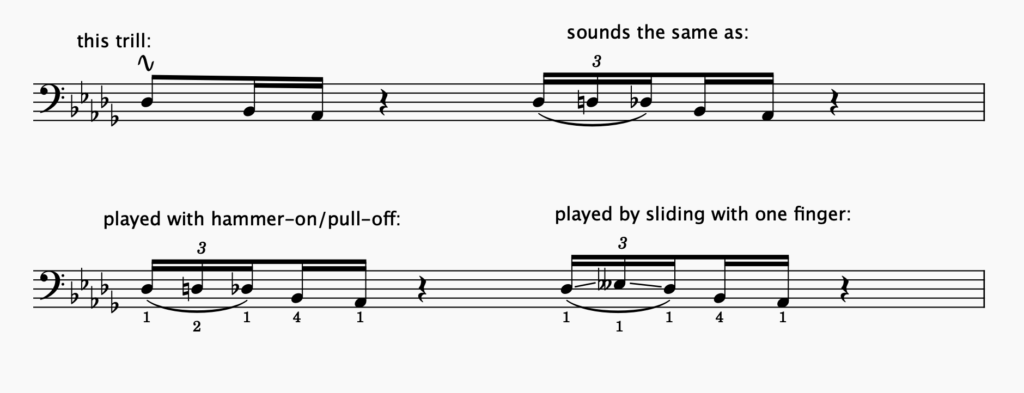
My use of the big vibrato squiggle is designed to keep the chart as simple as possible. My personal preference is to play the trills with a single finger, sliding up and down in quick succession – this is easiest if you involve the elbow and make it more of a ‘whole arm’ movement, rather than thinking of it as something for your fingers to take care of.
There’s lots of great stuff to steal from Joe Dart in this section. Here are my observations:
- The main groove smells an awful lot like James Jamerson, with heavy use of root-6th-5th patterns.
- The fills at bars 48, 52, and 54 are straight-up major pentatonic scale vocabulary with the use of the minor 3rd as a chromatic passing tone. If you don’t know what those terms mean, then it looks like that’s your homework sorted. You might also notice that these sound just like part of Stevie Wonder’s ‘Sir Duke’ unison line.
- Bar 51 features some rapid-fire root-5th-octave movements that might catch you out.