
Bass transcription: The Beatles – “Something”
One of the more famous Beatles songs composed and sung by George Harrison, “Something” was also the groups only UK Number 1 single that wasn’t credited to Lennon and McCartney. Taken from The Beatles’ eleventh studio album, Abbey Road, “Something” features Paul McCartney at his most melodic on not just one, but two bass parts.
Two bass parts? Before we dig into the details, take another listen to “Something” and see if you can spot the second bass part, which enters at the bridge:
During my initial efforts to transcribe Paul’s part I kept imagining that I was hearing two bass notes at once during the outro – no matter how many times I re-listened to it, I couldn’t decide which octave McCartney was playing in.
Then I stumbled on this wonderful video that gives us access to the isolated tracks from “Something”, including the overdubbed second part:
The Beatles – “Something” bass transcription PDF
There are so many great things in this transcription that I couldn’t help but make a video going on a deep dive into the bassline and the chord progression. If you’ve struggled with slash chords or been mystified by modal interchange, then this is for you:
The Beatles – “Something”: bass transcription notes
Let’s deal with the main bass part first. There’s so much great stuff in Paul McCartney’s part that it’s hard not to write about every single bar, but here are my main observations about the bassline and harmony of “Something”:
Sound/articulation
Paul played “Something” with a pick, using what sounds like downstrokes at all times – listen to the repeated 16th note Cs during the verses on the isolated track.
The bass part features numerous slides, and it was tricky to notate every nuance: Paul seems fond of sliding out of almost every note, and his slides fall into three main categories:
1. Slides to nowhere
These are what I’d refer to as “falling off” a note; the slide moves up or down the fretboard, but the destination doesn’t have a specific pitch. I’ve tried to show this in the notation by finishing the slide lines in empty space on the stave.
2. Slides linking two notes, where both notes are plucked (or picked)
Pluck the note, slide to the next one, and pluck it. Simple. Shown on the notation where the slide clearly ends at the next notehead.
3. Slides linking two notes where only the first is plucked
Play the first note, slide to the desired pitch, but don’t pluck the second note. These are indicated by a slide with a curved line (a slur marking) above.
Vibrato
Call me old-fashioned, but I definitely remember a time before YouTube and Instagram when nervously wobbling your fingers on every long note becuase it gives your playing a ‘vibe’ was a no-no.
As someone who has dissected hundreds of basslines, I can say that I’ve heard very little vibrato. But if we look at bars 4 and 8 of the chart we can clearly see Paul applying a fair amount of wobble to his sustained notes. If this is a new technique to you, then be patient – the isolated bass part will teach you much more than the notation where this is concerned.
Harmony
There’s a huge amount to talk about if we look at the chord progressions used in “Something”. For me, the most interesting aspects are:
1. Slash chords
Bass players have tremendous power when it comes to chord progressions, because we decide what the bass note is. Don’t get me wrong, it’s best to play the root 90% of the time so you don’t get fired, but in some situations you can play other chord tones to create slash chords.
Slash chords (written as the chord, followed by the bass note, separated by a slash) are a great device for smoothing out the bass note movement in chord progressions. Notice how the opening chord sequence is actually F – Eb – G – D, but Sir Paul’s decision to play a D under the G chord makes the jumps between bass notes smaller.
The bridge section is a masterclass in using slash chords (or, more precisely, inversions of chords) to achieve a wonderfully logical-sounding, descending bass part. McCartney links the changing bass notes together using a repeated motif, which makes the line both melodic and memorable.
2. Chromatic Embellishment of Static Harmony (a.k.a. a “line cliché”)
There are two chord progressions in “Something” that employ what music school-types call “Chromatic Embellishment of Static Harmony”, also referred to as a “line cliché” because it’s such a common compositional device.
The first four chords of the verse, C – C major 7 – C7 – F, contain their own internal chromatic melody that drops by a semitone with each chord change. This sounds much more interesting compared with having three bars of plain C major. The ‘B’ section of the verse features the same trick, but in the relative minor key of A minor.
3. Modal interchange
Right from the start of the song, there are chords that don’t belong in the key of C major; there’s an Eb major in the intro, and D7 in the verse. But how come they sound good if they’re technically not allowed? In addition to that, how do we talk about them and label them?
The answer is a very painful-sounding term called modal interchange, a.k.a “borrowed chords” or “non-diatonic chord substitutions”. It turns out that the C major scale is the main source of chords for this song, but it’s not the only one…
We can also visit the parallel minor scale of C minor and “borrow” chords from there (parallel means same root note). Using both the C major and C minor scales gives us this array of possibilities for chords:
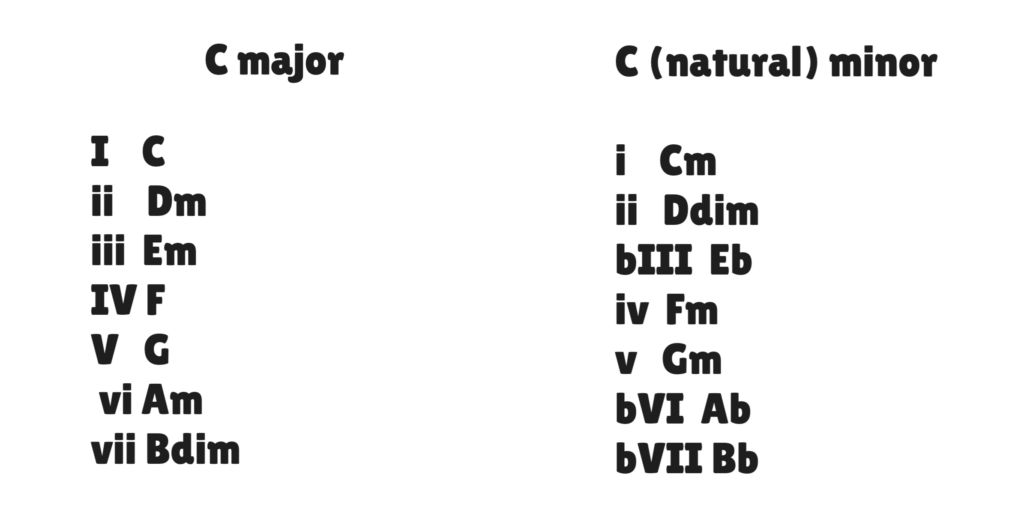
So, we can label the Eb major chord as bIII (“flat 3 major”), as that’s it’s position in C minor. Common borrowed chords that appear all the time are the minor iv chord, which has a wonderful (some would say cheesy) yearning quality to it, bVI and bVII (useful for turnarounds), and a major/dominant V chord (borrowed from the harmonic minor scale).
Something’s second bass part
During the bridge section a second, overdubbed bass part comes in. This is transcribed on the last page of the chart, and features Paul McCartney playing a much simpler line than the main bass part. Comprised mainly of long root notes played in lower octaves, the inclusion of the overdub in the main mix of “Something” helps to anchor the bass part(s), particularly during the outro, where the original part ascends to the higher reaches of the fretboard.

Struggling with syncopation?
Put yourself through the bootcamp!
Rhythm Reading Bootcamp Volume 2 is the exact method that I use to help my students master advanced rhythmic concepts. Over 80 carefully written exercises to build your confidence with 16th-note patterns and syncopation.